Book binding glossary: 40 terms, illustrated.
Recognise the parts, compare the constructions, and describe the book you want to make.
Book binding terms describe how pages are assembled, attached to a cover and finished. This illustrated glossary explains 40 terms commonly found in print specifications and supplier quotes. Use it to identify a part or process, then confirm the exact construction, paper and opening behaviour with your printer before approving a sample.
The text block
Start with the paper and the parts of an opening.
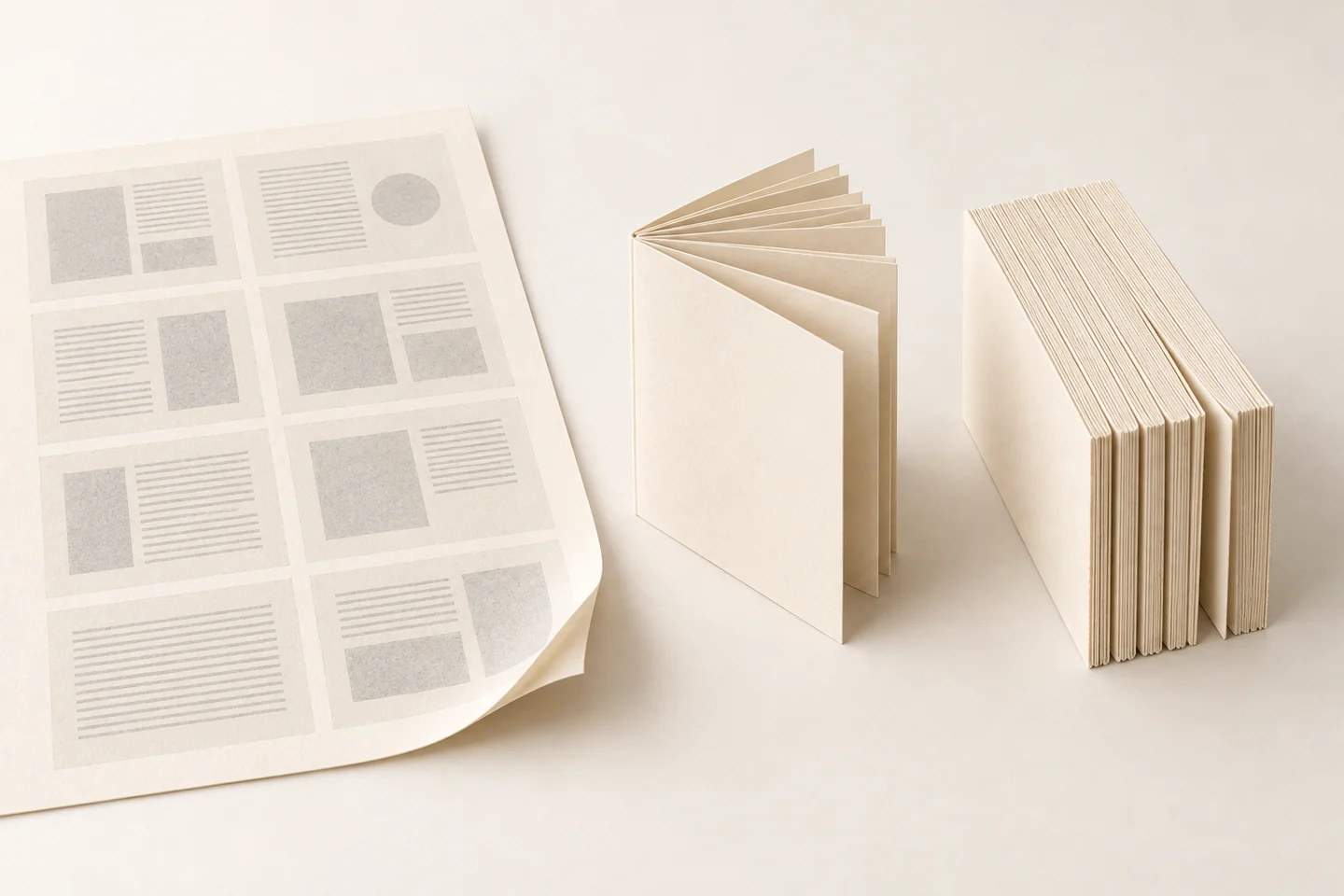
- Signature (section)
- A folded section of pages, commonly 16 or 32 in commercial book production. The section size depends on the format, paper and folding scheme.
- Leaf
- One physical piece of paper in the book, carrying two pages, one on each side.
- Recto and verso
- In the left-to-right book shown here, recto is the right-hand, odd-numbered page and verso is the left-hand, even-numbered page.
- Gutter
- The inner margin, where the page curves into the binding and careless artwork goes to disappear.
- Text block (book block)
- The assembled body of a book’s pages, before its cover is attached. It may consist of folded signatures or individual leaves, depending on the construction.
- Gathering
- Collating folded signatures into order; the step where a sequence error becomes a very memorable book.
- Endpapers (endsheets)
- The folded sheets joining a hardcover block to its case, half pasted down, half flying free.
- Hinge
- The flexing line inside the cover where the book actually opens.
For your quote: Confirm the page-count increments and whether endpapers are included in the quoted extent.
Sewing and stitching
Look at where the thread or wire passes through the paper.
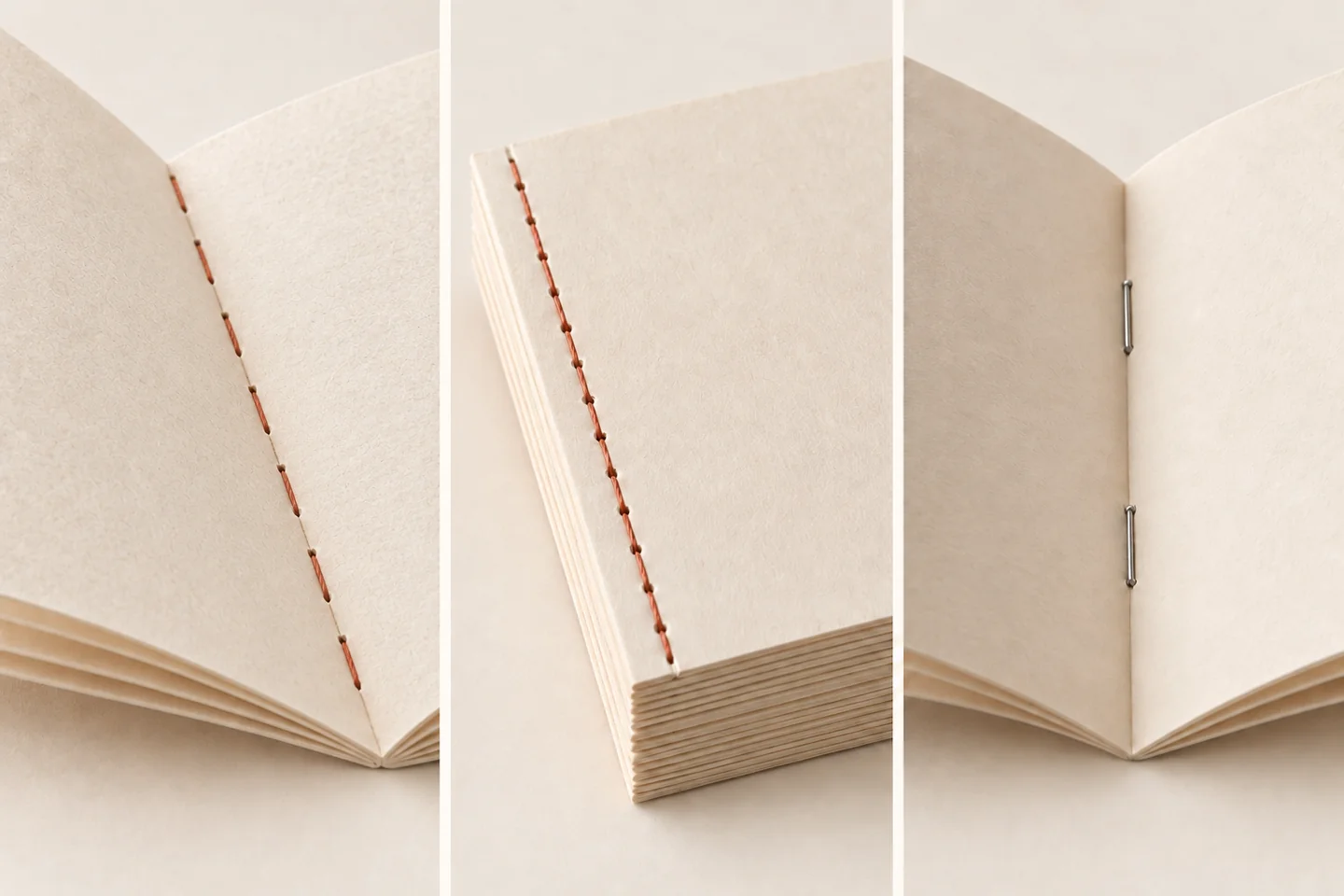
- Smyth sewing (section sewing)
- Machine sewing that joins folded signatures through their folds and to neighbouring sections; a common construction for books intended for repeated use.
- Side sewing
- Thread passes through the thickness of the book block near the spine edge. It makes a secure attachment but restricts opening more than through-fold sewing.
- Saddle stitch
- Wire staples through the fold of nested sheets; the binding of thin catalogs and picture books.
- Sewn paperback
- A section-sewn text block finished with a soft cover. Sewing and cover construction are separate specifications.
- Mull
- Open-weave cloth glued along the spine to reinforce the book block; also called super or crash.
- Spine lining
- Paper, cloth or other layers applied to prepare and reinforce the spine. The materials and arrangement depend on the binding construction.
- Swell
- The extra thickness thread adds at the spine; managed, never quite eliminated.
- Smashing
- Pressing sewn blocks flat under high force so the swell behaves; the trade never renamed it.
For your quote: Specify how the pages are joined as well as whether the cover is hard or soft.
Glue and mechanical bindings
Separate the binding structure from the adhesive specification.
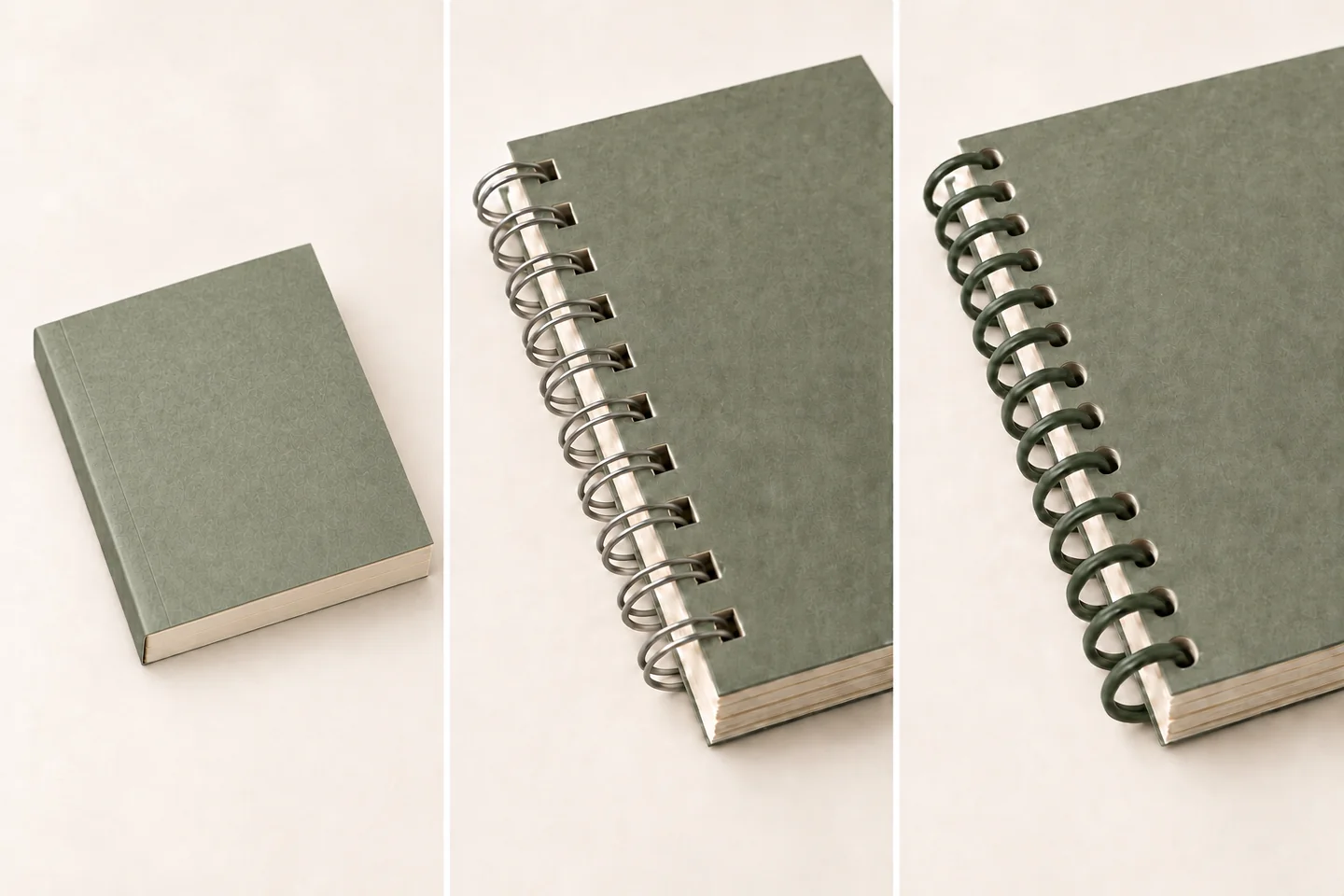
- Perfect binding
- An adhesive binding in which prepared page edges are bonded at the spine and attached to a wraparound soft cover; a common paperback construction.
- Milling
- Grinding the folds off a gathered block so glue can reach every individual page edge.
- EVA
- Ethylene-vinyl acetate hot-melt adhesive, which sets as it cools. Widely used for economical everyday binding; suitability depends on the paper, printing and intended use.
- PUR
- Polyurethane-reactive adhesive that cures with moisture. Often chosen for demanding papers and durable adhesive bindings; performance and curing requirements depend on the formulation and production conditions.
- Notch binding
- A compromise that keeps the folds and cuts glue channels into them instead of milling.
- Lay-flat binding
- A broad term for constructions intended to let a book remain open with little resistance. Otabind is one softcover example, with the text-block spine free from the cover spine. Confirm opening behaviour with a sample.
- Wire-O (twin-loop wire)
- Paired steel loops closed through punched holes; pages align level across the spread.
- Spiral coil
- One continuous plastic or metal helix threaded through punched holes. Plastic coil is flexible and lets pages turn around the binding; protect it during packing and shipping.
For your quote: Name the opening requirement and let the printer confirm an adhesive suited to the paper and process.
Cases and covers
The case is made separately, then joined to the book block.
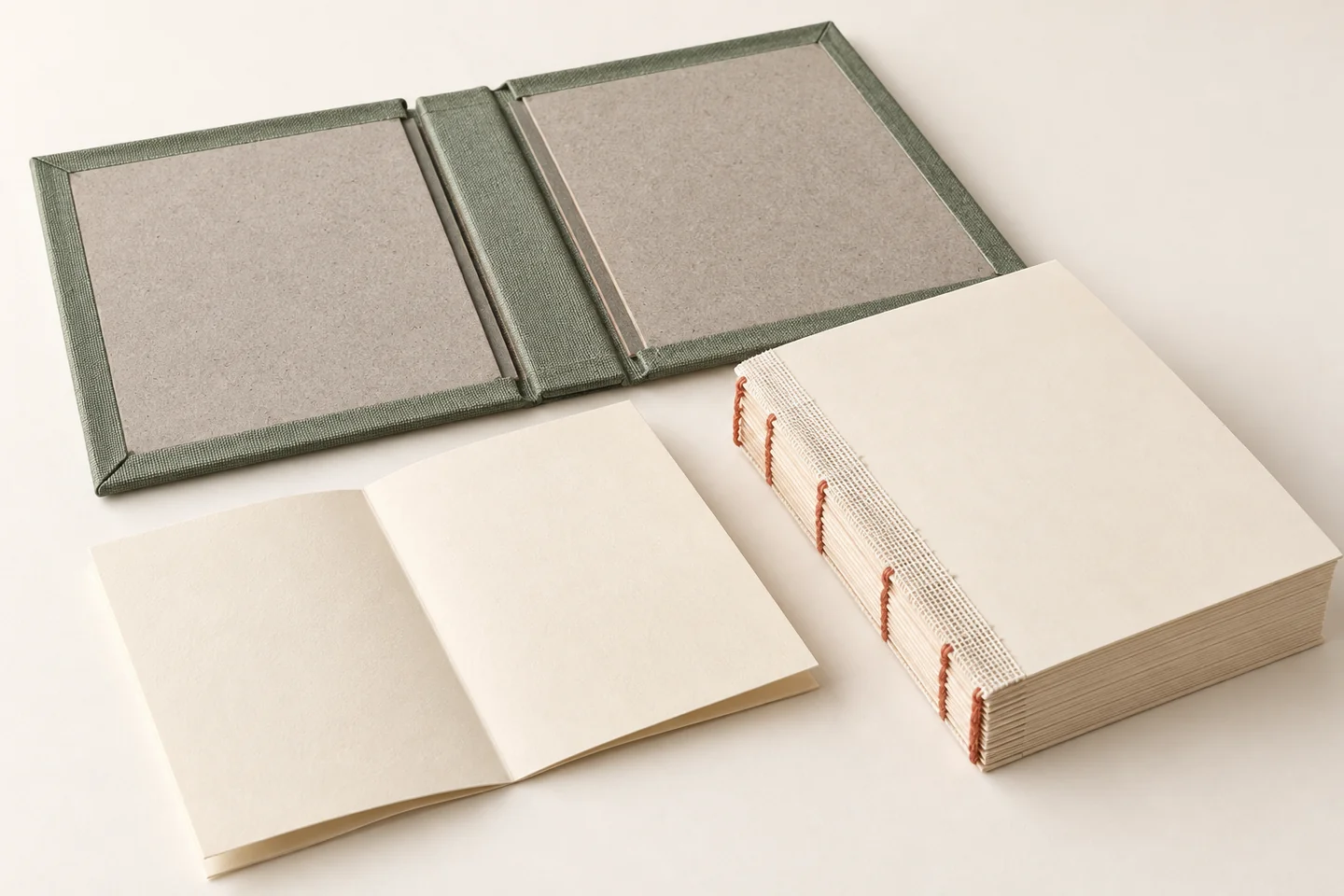
- Case
- The hard cover as a separate manufactured object: two boards and a spine piece under one covering.
- Binder's board
- The dense board inside a hardcover. Its thickness and stiffness should suit the book’s format and construction.
- Book cloth
- Fabric prepared for covering books, often paper-backed or otherwise treated to improve handling and control adhesive penetration. The weave and finish affect foil and other decoration.
- Turn-in
- The covering material wrapped over the board edges to the inside, later hidden by the endpapers.
- Square
- The small lip of case overhanging the block on three sides, standing guard over the pages.
- Joint
- The pressed groove beside the spine that lets a heavy case open without fighting the board.
- Rounding and backing
- Shaping a sewn spine into a curve and forming shoulders to accommodate the boards; a construction choice for round-backed books.
- Casing in
- Marrying block to case with pasted endpapers; the moment a book becomes a book.
For your quote: Confirm the board, covering material and endpaper stock together.
Details buyers notice
Describe the material, position and effect of each finish.
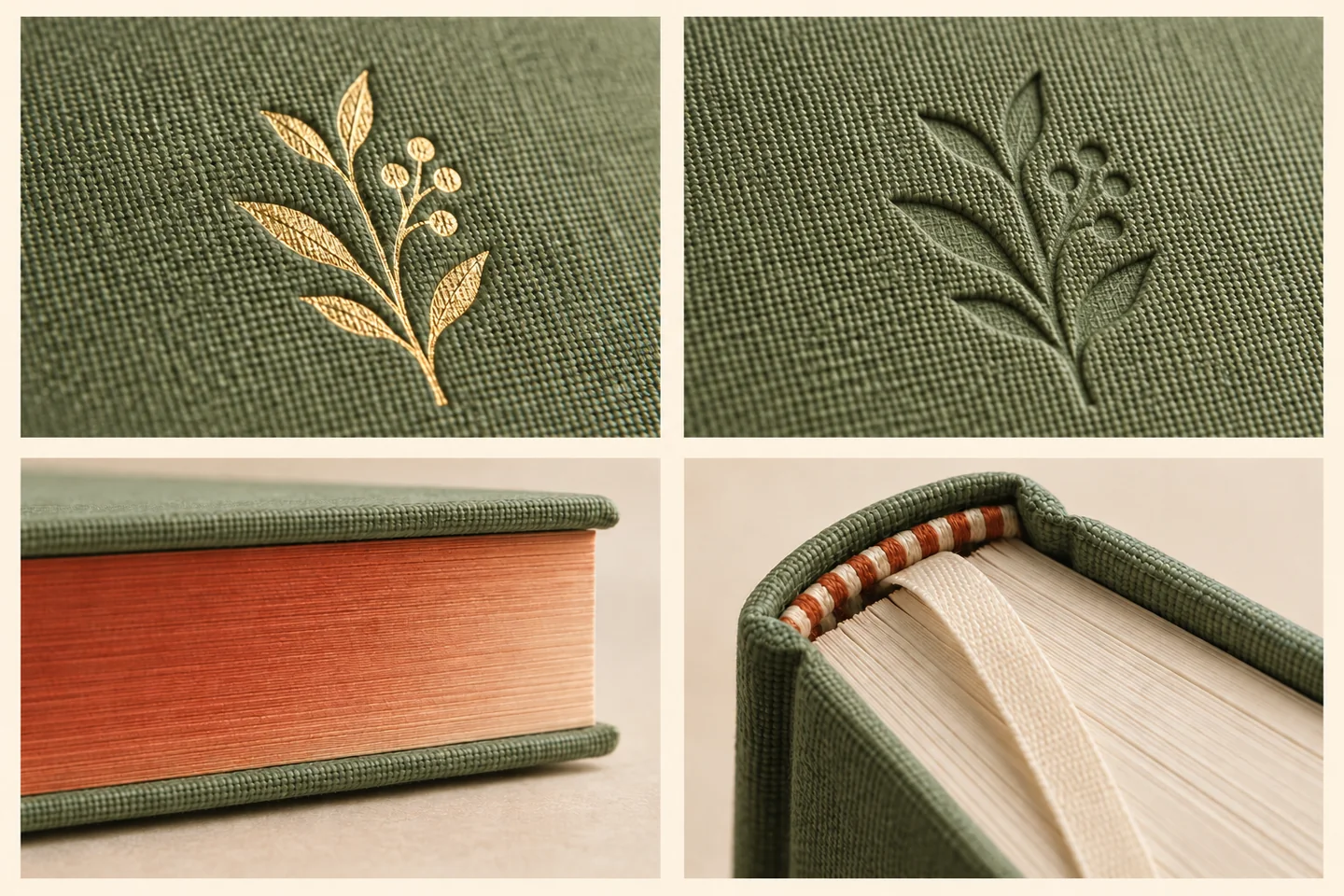
- Headband
- A small band at the head of the spine, often matched by a tailband at the foot; together, endbands. In modern trade books these are usually applied decorative components, not evidence that the text block is sewn.
- Ribbon marker
- The bound-in bookmark, anchored under the spine lining rather than glued to a page.
- Dust jacket
- The printed, removable wrap around a hardcover, its flaps tucked around the boards.
- French flaps
- Jacket-style flaps folded into a paperback cover; a softcover borrowing hardcover manners.
- Lamination
- The thin film, gloss, matt or soft-touch, that protects a printed cover.
- Foil stamping
- Metallic or pigment foil pressed into the cover with a heated die.
- Blind deboss
- A design pressed down into the cover surface without foil or ink. It is recessed; embossing raises the design above the surrounding surface.
- Sprayed edges
- Color, gradients or stencilled artwork applied to the trimmed edges of the block.
For your quote: List each finish and its location; send a reference image for a combined effect.
Illustrations are AI-generated explanations of book construction and finishing.
Use the terms to read a quote
- Cover and page attachment
- A hardcover may contain a sewn or adhesive-bound text block, and a sewn text block can also have a soft cover. Specify both parts of the construction.
- Binding and adhesive
- Perfect binding describes a construction; EVA and PUR describe adhesive types. Ask which system suits the selected paper, printing and intended use.
- Opening behaviour
- If the book must remain open on a desk, state that requirement separately and assess a physical sample. A binding name alone does not show how your paper and page count will behave.
Describe finishing by material, position and effect: gold foil on the front cover, blind deboss on cloth, or colour on the fore-edge. A reference image helps when several processes are combined. List foil, blind deboss and lamination separately where required.
Before finalising your files, confirm:
- Which page-count increments suit the chosen production method.
- Whether the quoted extent includes endpapers and other additional leaves.
- Which physical sample will be used to approve opening and finishing.
When a term needs a longer answer
Use the glossary to start a precise conversation. For the full construction, read our guides to case binding and hardcover anatomy below. If a supplier uses an unfamiliar term, ask them to identify the part or process and show it on a sample.
Technical references: ODM · KLEIBERIT · Profoil
Updated 30 October 2026